India Couture Week 2026: What Indian Couture Actually Costs
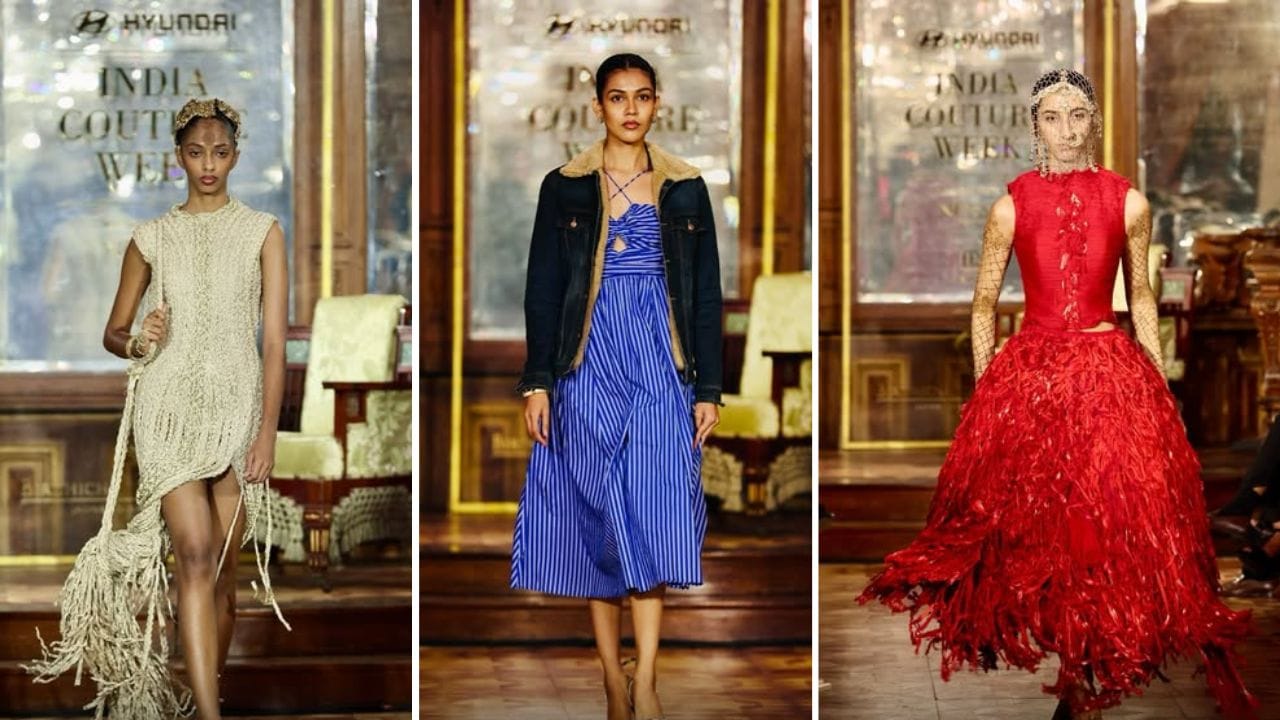
India Couture Week 2026 just concluded its 19th edition, and if there is one headline beyond the sequins and sculptural silhouettes, it is this: Indian couture has never been more expensive, more internationally relevant, or more certain of its own worth.
The week ran July 23–30, opening with Anamika Khanna at Hyderabad’s Falaknuma Palace before the main programme moved to Taj Palace, New Delhi. Gaurav Gupta chose to separate himself entirely — showing Light Song at Jio World Convention Centre, Mumbai on July 17, ahead of the formal FDCI calendar. The effect was to give the season two premiere moments instead of one, and to signal that India’s biggest couture name no longer needs a fashion week to anchor his significance.
The Designers — and What They Actually Charge
Gaurav Gupta — ₹5 lakh to ₹35 lakh
Light Song was the collection of the season: 70+ looks developed over nine months by more than 200 artisans, representing 6,000 hours of hand craftsmanship. Architectural draping, sculptural silhouettes, a debut menswear chapter, and couture innovation that would look entirely at home in Paris. Entry into the Gupta universe starts at approximately ₹5 lakh for cocktail pieces. Signature bridal lehengas: ₹15–35 lakh. Custom menswear: ₹3–8 lakh.
Tarun Tahiliani — ₹3 lakh to ₹25 lakh
Navaratna — nine jewels — transformed Bikaner House, New Delhi into a multi-sensory immersive walkthrough rather than a traditional runway. Thirty years of craft heritage distilled into an experience that felt more gallery than fashion show. The atelier’s bridal lehengas sit at ₹8–25 lakh; evening separates and anarkalis range from ₹3–6 lakh. The format was a statement as much as the clothes: ICW is growing up.
Rahul Mishra — ₹4 lakh to ₹20 lakh
The grand finale on July 29. Mishra’s Paris Couture Week Fall 2026 collection had already generated serious international press, and ICW got the Indian premiere. Hand-worked zardozi, botanical motifs, intricate three-dimensional surface treatments produced in his Noida atelier. A Rahul Mishra bridal lehenga is a commitment: ₹8–20 lakh, with a 6–9 month production timeline and a waiting list that rewards early decisions considerably.
Anamika Khanna — ₹2.5 lakh to ₹18 lakh
The opening act at Falaknuma, a venue that does 40% of the creative work simply by existing. Khanna’s handloom-forward approach and deconstructed silhouettes have made her the designer of choice for the buyer who wants couture that feels cultural rather than overtly bridal. Entry-level fusion wear: ₹2.5–5 lakh. Signature bridal separates and lehengas: ₹8–18 lakh.
Falguni Shane Peacock — ₹1.5 lakh to ₹12 lakh
The most wearable end of the ICW spectrum without compromising on the drama. FSP’s embellished gowns and lehengas have a distinctly global appeal — worn at Indian weddings in London, Dubai, and Singapore as readily as in Lutyens’ Delhi. Entry price for separates: ₹1.5 lakh. Full bridal sets: ₹6–12 lakh.
What HEII Actually Recommends
First-time couture buyer: start with FSP separates or bridge-to-luxury lines (Tahiliani’s Tasva runs ₹40,000–1.5 lakh). Serious bridal investment: Gaurav Gupta or Rahul Mishra, planned 9–12 months in advance. Buyer who wants craft over spectacle: Anamika Khanna and Mishra are without equal.
HEII Score: 3/5 ★★★
- ICW 2026 delivered its most globally ambitious edition with craft that competes internationally ✅
- Price architecture from ₹1.5L entry to ₹35L signature makes couture legible for first-timers ✅
- Immersive formats — Navaratna at Bikaner House, Gupta at Jio World — are elevating the buying experience ✅
- Lead times of 6–12 months for bespoke require serious advance planning ⚠️
Verdict: India Couture Week 2026 was the most convincing argument yet that Indian couture belongs in the same conversation as Paris, Milan, and New York — not as an imitation, but as something categorically its own. The price tags are no longer a surprise. They are a statement of arrival.